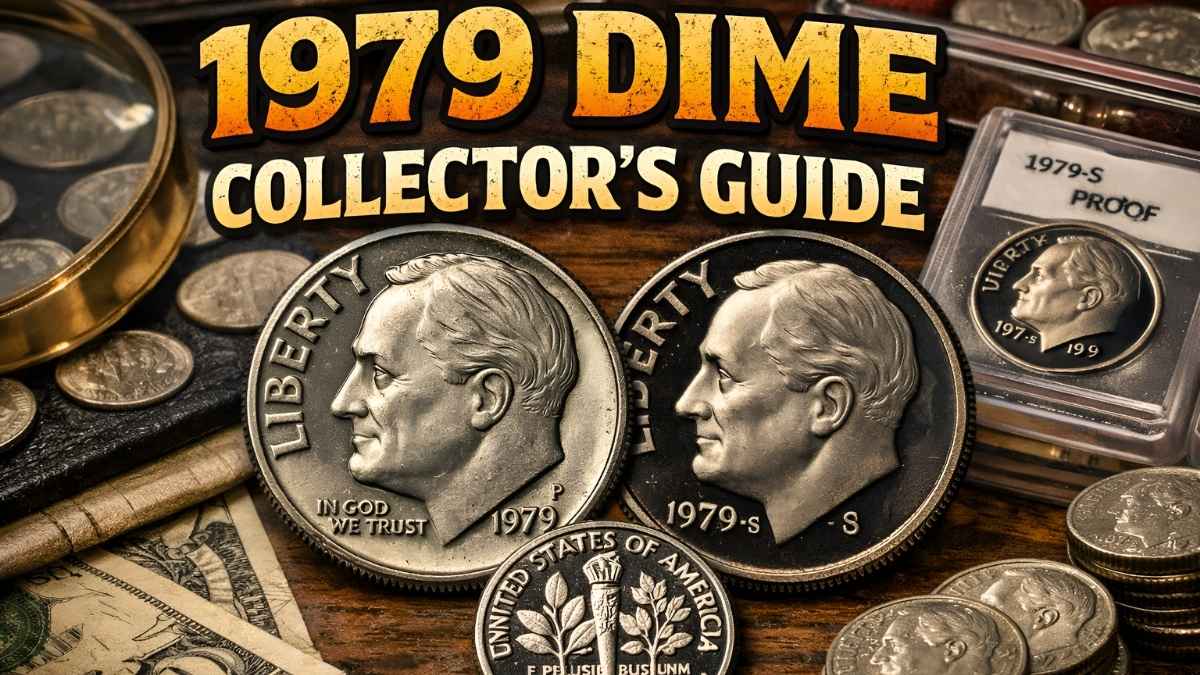
1979 Dime Collectors Guide: Coin collecting is a fascinating pursuit that blends history, artistry, and financial opportunity. Among modern U.S. coins, the Roosevelt dime series holds a special place. While most 1979 dimes are common and circulate at face value, certain rare varieties and minting errors have made this year’s issue particularly interesting for collectors. Understanding the value and market demand for 1979 dimes requires examining condition, rarity, and unique characteristics.
The Story Behind the 1979 Dime
The Roosevelt dime was first introduced in 1946 to honor President Franklin D. Roosevelt. Designed by John R. Sinnock, the coin features Roosevelt’s portrait on the obverse and a torch flanked by an olive branch and oak branch on the reverse. By 1979, the dime had already become a familiar part of American currency, struck in copper-nickel clad composition rather than silver.
Why 1979 Dimes Are Valuable
Not every 1979 dime is rare, but specific factors contribute to higher values:

- Minting Errors: Coins with doubled dies, off center strikes, or wrong planchet errors are scarce and collectible.
- Condition: Uncirculated or proof examples in pristine condition command premium prices.
- Mintmarks: Dimes struck at Denver (D), Philadelphia (no mintmark), and San Francisco (S) can vary in rarity depending on production numbers and varieties.
- Collector Demand: Historical significance and unique varieties increase desirability.
Error Varieties and Rare Finds
Several error varieties of the 1979 dime have been reported:
- Doubled die obverse coins with noticeable doubling on lettering.
- Off center strikes that create visually distinctive misalignments.
- Wrong planchet errors where the design was struck on a coin blank intended for another denomination.
- Proof coins with variations in mintmark style, especially from the San Francisco Mint.
Market Prices Explained
The value of the 1979 dime varies widely depending on rarity and condition:
- Circulated examples: Worth face value.
- Uncirculated examples: Can sell for 2 to 10 dollars.
- Proof or high grade certified coins: Often range from 20 to 100 dollars.
- Error coins: Depending on severity, can fetch hundreds or even thousands of dollars.
The Role of Condition and Grading
Professional grading services such as PCGS and NGC play a crucial role in determining coin values. Coins certified at Mint State levels are far more valuable than raw examples. Market prices increase exponentially with higher grades, especially for rare error varieties.
Collecting Strategies
For those interested in the 1979 dime, consider these approaches:
- Search coin rolls and collections for anomalies.
- Focus on proof issues from San Francisco, which are known for unique varieties.
- Prioritize coins graded by professional services to ensure authenticity.
- Explore error coins that add uniqueness to a collection.
Investment Potential
The 1979 dime offers both numismatic and historical value. While most examples are common, rare varieties can appreciate significantly over time. The combination of historical significance, condition, and collector demand makes it a unique investment opportunity.
Cultural Significance
Beyond monetary value, the Roosevelt dime holds cultural meaning. It commemorates President Roosevelt’s legacy and symbolizes America’s resilience during the Great Depression and World War II. Collectors often view these coins not only as investments but also as tangible connections to history.
Conclusion
The 1979 dime is more than just pocket change. Rare varieties, error coins, and high grade examples can bring substantial profits to collectors. Market prices depend on rarity, condition, and demand, with some coins worth hundreds or even thousands of dollars. For enthusiasts, the pursuit of these treasures is both financially rewarding and historically enriching. The next time you examine your wallet or coin jar, take a closer look you might discover a 1979 dime that connects you to America’s numismatic legacy while offering unexpected value in the present.